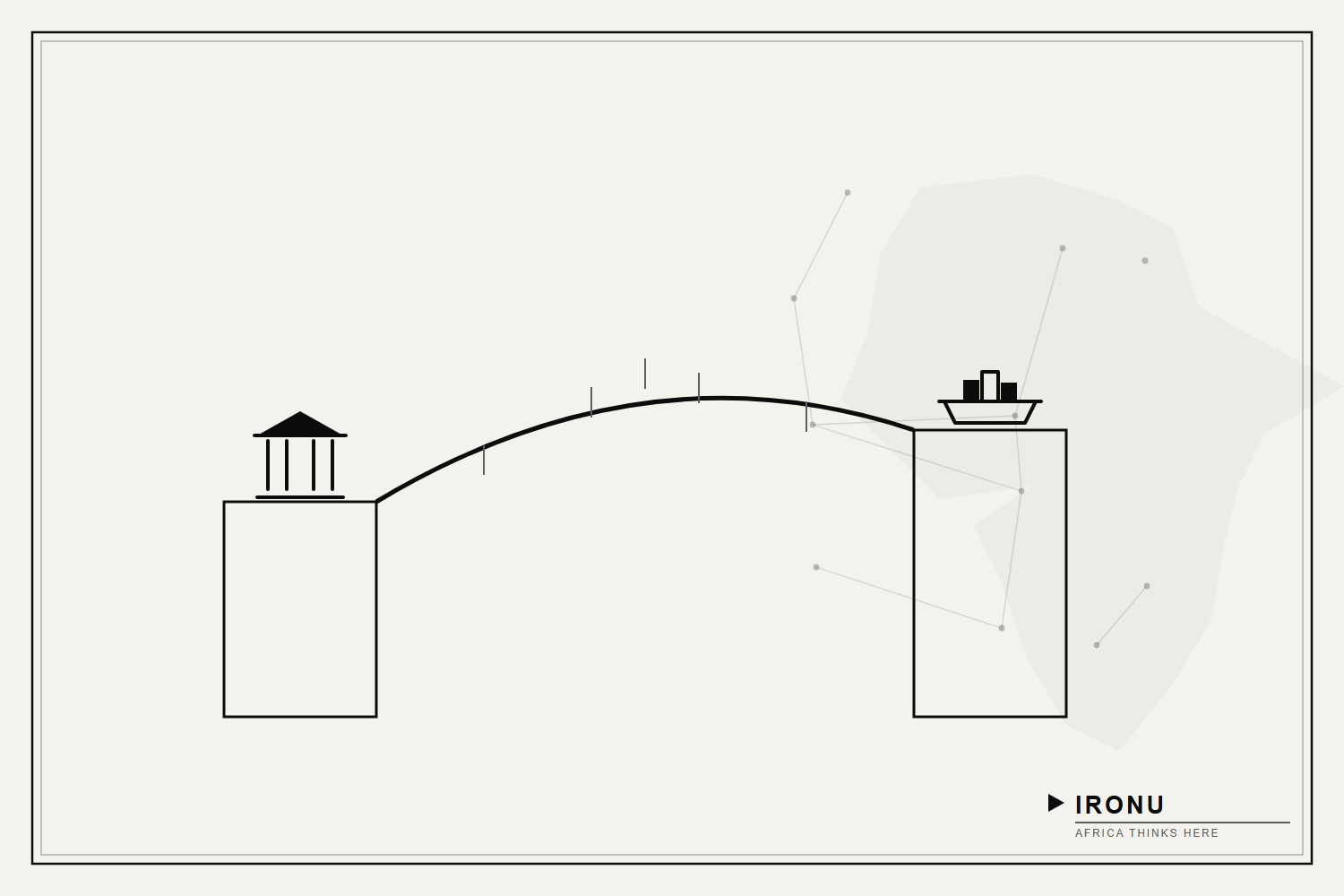

A bridge looks like a local object — one river, one crossing, one country. Read as an asset, it is something else: a single node whose value comes entirely from the network it completes. Until this week, the River Gambia interrupted the Trans-Gambia corridor, forcing traffic between northern and southern Senegal onto a ferry that capped the whole route to the throughput of one boat. The Senegambia Bridge, now open to traffic, removes that cap. The interesting question for a strategist is not what the bridge is, but what model it encodes — and whether that model travels.
The Framework: A Corridor Is Only As Strong As Its Weakest Link
Infrastructure economists describe a trade route as a chain of segments, each with its own capacity, and the whole chain runs at the speed of its tightest constraint. The Trans-Gambia corridor had good road on either side and a single fragile link in the middle: the river. Investing anywhere but that link would have added capacity the corridor could not use. The Senegambia Bridge is a textbook case of spending at the binding constraint — the point where a fixed sum of capital buys the largest system-wide gain.
That is the transferable idea. Across West Africa, corridors fail not for lack of tarmac but for a handful of chokepoints: a river without a bridge, a border without a joint post, a port without a rail spur. The model here is diagnostic before it is physical — find the segment that governs the whole, then build only there.
Capital placed at the binding constraint does the work of capital placed everywhere else.
The Policy Logic: Bilateral Asset, Regional Return
The bridge sits inside one country but serves two, and its logic is regional. The Gambia carries a domestic asset whose largest beneficiaries include Senegalese freight and the broader ECOWAS road network. That asymmetry is the model’s most delicate assumption: it works when neighbours coordinate on financing, tariffs and border procedure, and it strains when they do not. The involvement of a multilateral backer helps precisely because it aligns incentives that a single national budget might not. The strategic template is a shared-corridor asset financed and governed as a regional good rather than a national one.
This is where second-order effects live. A fixed link changes the bargaining position of every town along the route, the pricing power of the ferry operators it replaces, and the calculus of any firm that had routed around The Gambia to avoid the crossing. The asset reorders the map around it.
An asset that serves two countries must be governed by both, or it underperforms for one.
The Assumptions That Could Fail Elsewhere
For an operator asking whether this model transfers, the honest work is listing where it breaks. First, the constraint must genuinely be singular; a corridor with three chokepoints does not yield to one bridge. Second, the flanking roads must already exist and perform — a bridge to a bad road banks little. Third, the soft infrastructure must move with the hard: customs harmonisation, transit guarantees and predictable crossing charges. The engineering gain in transit time is real, but it converts to commercial gain only if border processing does not reclaim the hours the bridge just saved. Published crossing tariffs and clearance protocols are not yet on the record [TK], and those govern the realised return.
There is also an ownership question worth flagging as an intellectual-property matter of a kind: who holds the tolling model, the traffic data and the maintenance obligation over the asset’s life. A corridor asset generates a stream of information — volumes, seasonality, commodity mix — that is itself valuable to any operator planning the next node. The party that controls that data controls the next investment decision.
A model transfers only where its hidden assumptions also hold.
The Decision For The Operator
The strategic takeaway as of today is that West Africa’s corridor problem is legible and, at specific points, solvable with concentrated capital. For a founder, financier or public institution, the Senegambia Bridge is less a destination than a method: identify the segment that caps a route, verify that the flanking assets and the soft infrastructure can absorb the new capacity, and finance the single node as a shared regional good. Applied carelessly, the template builds monuments; applied with a real constraint analysis, it unlocks whole routes. The map now shows one fewer chokepoint on the Dakar–Ziguinchor axis. The intelligent question is which chokepoint is next, and whether the same model fits it.
Build the bridge the corridor is actually waiting for, not the one that looks most like progress.