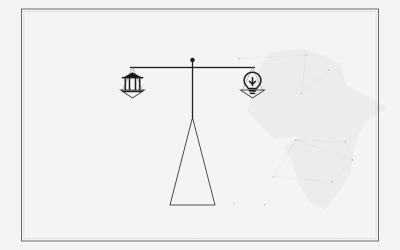

Institutions are arguments made physical. When a continental trade body chooses a home, it is not only picking a city — it is asserting a model of how integration should work, and where its centre of gravity should sit. For years AfCFTA was a framework without that assertion. This week it made one: the permanent AfCFTA Secretariat was commissioned in Accra, making Ghana the host of continental trade implementation. The interesting question is not the ceremony but the framework it encodes — and whether that framework travels.
The Development: The Logic of a Permanent Centre
Siting a permanent headquarters concentrates trade diplomacy and policy expertise in one place, and that choice carries a theory. Continental integration could, in principle, be run as a distributed network of national focal points. Instead AfCFTA has been given a single institutional core in Accra, on the logic that rule-making, dispute resolution and technical harmonisation work better with critical mass — a concentrated pool of expertise, a fixed address for negotiation, and an accumulating institutional memory. The model is centripetal: pull the scarce talent and authority into one node so the whole system can draw on it.
The takeaway: the Secretariat encodes a bet that integration is built at a centre, not only at the borders.
The Framework: Agglomeration as Strategy
The strategic model at work is agglomeration — the same logic that clusters finance in a handful of cities or technology in a few valleys. Concentrating trade-policy expertise, diplomatic activity and the associated professional services in Accra is meant to generate returns that a dispersed arrangement could not: faster learning, denser networks, and a location advantage for the host economy. Placing a West African capital at the centre of Africa’s continental trade architecture is a deliberate act of institutional geography.
The second-order effects are where the model earns or loses its keep. If agglomeration works, Accra becomes a self-reinforcing hub: talent attracts institutions, institutions attract firms, firms attract more talent. If it underperforms, the concentration mainly produces a conference economy — real but shallow — without the deeper transfer of capability into the wider Ghanaian economy. The framework’s promise and its risk are the same mechanism seen from two sides.
The takeaway: agglomeration compounds when capability spreads beyond the institution, and stalls when it does not.
Transferability: Which Assumptions Could Fail
The discipline Ironu applies to any model is to ask whether it transfers and where it breaks. The Accra model rests on several assumptions. It assumes a host with the stability, connectivity and professional base to sustain an institutional cluster — conditions Ghana meets more easily than some peers, which is itself part of the case for the location. It assumes that concentrating policy expertise translates into economy-wide benefit rather than an enclave. And it assumes member states keep funding and empowering the centre so that its authority is real.
Each assumption could fail in another West African market. A host without reliable power, connectivity and professional depth would struggle to hold the cluster. A political settlement that starved the institution of funding or authority would leave an impressive building running an empty mandate. For an operator, the lesson is not that agglomeration is wrong but that it is conditional — the model works where the enabling conditions hold, and those conditions are unevenly distributed across the region.
The takeaway: a hub is only a hub if the host can carry it and the members will fund it.
The Operator’s Read
For a strategist, policymaker or investor deciding whether to engage, the framework reading suggests a specific move: treat Accra’s new institutional weight as a durable structural feature and position for the second-order effects rather than the first. The near-term conference economy is the shallow layer; the deeper play is the expertise, standards-setting and networks that will accumulate around a permanent centre, and the firms — legal, advisory, logistics, standards and compliance — that can plug into them.
The measured conclusion is that the Secretariat is not just a location decision but a wager on agglomeration as the route to continental integration. It is a defensible wager, and Ghana is a reasonable place to make it — provided the capability spreads beyond the headquarters. Operators should back the model where its assumptions hold and watch, rather than assume, that they hold everywhere.
Study the model, not only the address.